



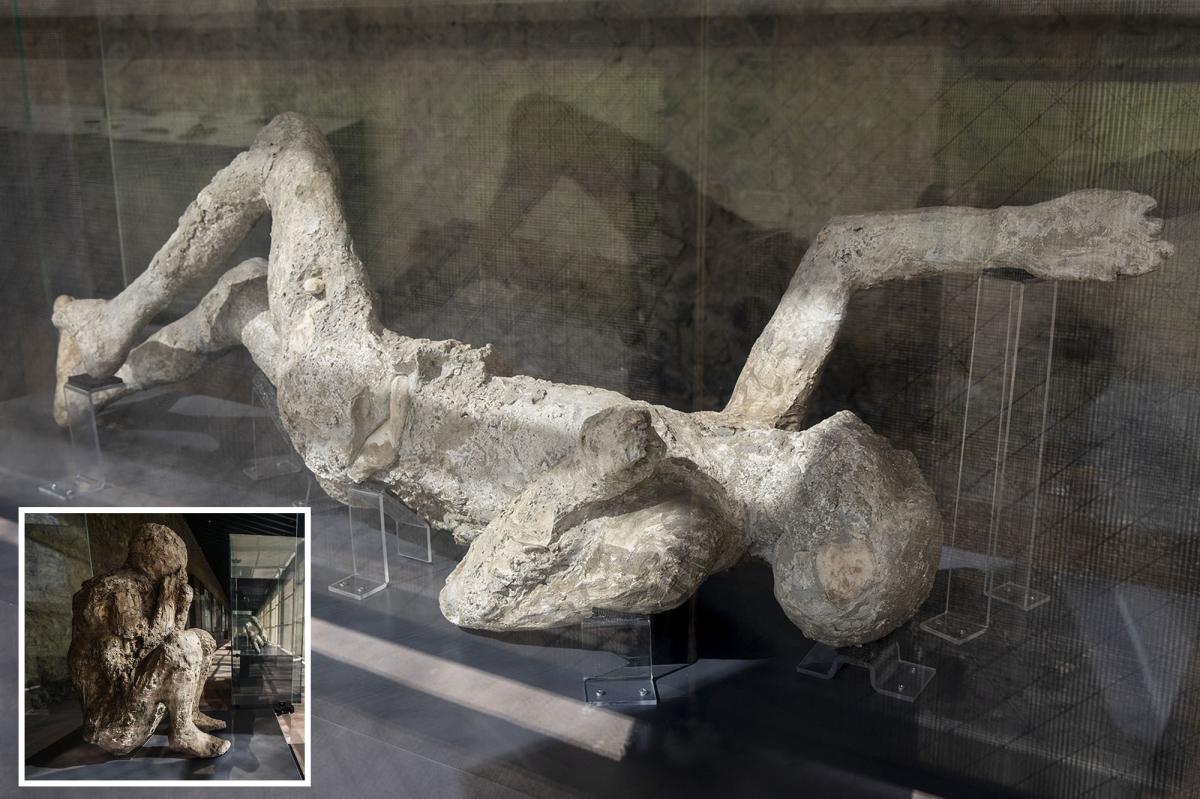
The first permanent exhibition of Pompeii’s historic casts is now on display in Italy, paying homage to those who were brutally killed after being engulfed by an inundation of volcanic ash.
The display features 22 of the best-preserved casts out of 100 taken, which were made by pouring plaster into the cavities left behind by the bodies found when Pompeii’s residents fell victim to the eruption of Mount Vesuvius in AD79.
The cavities were initially created when the ash hardened. While the buried bodies had almost entirely rotted away, the bones were left behind, which left molds that now give modern-day viewers a glimpse into the terror the Pompeiians likely experienced before their demise.
The display, which has a sign at the entrance imploring visitors to “proceed with respect and silence,” is filled with casts of 22 Pompeiians, all either curled up, hunched, in between kneeling and standing, and downright writhing.
“We want to tell the story of a tragedy that destroyed a city, the biggest natural disaster in antiquity, but also left us with an archaeological and historical treasure,” Gabriel Zuchtriegel, the Pompeii director, said at the opening of the exhibition at the site, as reported by The Times.
Below each body is a description of when and how it was found, as well as its state.
A heartbreaking pair of casts shows a man on his back, clenching his fists, with a small child balanced on his knees.
“We don’t know if this man was really clenching his fists or if the searing heat tightened his muscles as he died — either way it’s horrific,” archaeologist Silvia Bertesago told The Times.
One particularly haunting tale told at the exhibition is how one man, who was sitting with his knees tucked under his chin and his hands over his face, was likely covering his mouth with his cloak.
One woman found in 1976 was lying on her side near a city gate, surrounded by rings, coins and a small statue of the god Isis. Another had plant material covering her legs, which experts take to believe meant she was in the process of climbing a tree in order to escape the tragedy.
“We are recounting in a scientific way, for the first time, what happened in those hours,” Bertesago added.
When the eruption began, some of the nearly 20,000 residents of Pompeii had time to flee the scene as Vesuvius left small pumice stones over the city for a duration of 18 hours. About 1,000 residents — most of whom stayed indoors and were killed when pumice transformed into asphyxiating ash — have been found since the environmental disaster.
“I have worked at Pompeii for more than 20 years and I will never get over the emotional impact of these casts, which depict pain and death,” archaeologist Tiziana Rocco told The Times after being one of the first to visit the exhibition.
Read the full article here