



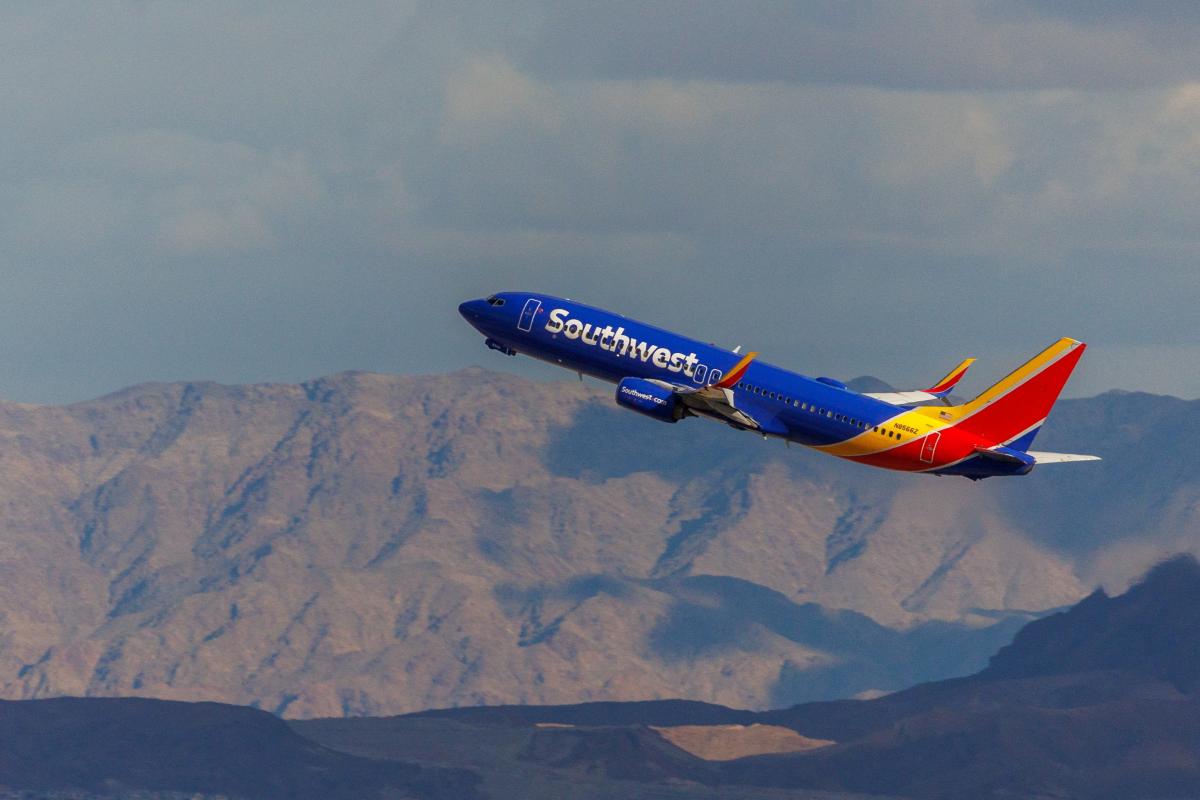
Southwest Airlines is cracking down on portable chargers, rolling out a strict new policy in which passengers can only bring one charger each and are barred from putting the devices in overhead bins due to concerns over midair fire risks.
The Dallas-based carrier said travelers will be allowed just one lithium-powered charger per person, capped at 100 watt-hours, and must keep the device either on their person or in a bag under the seat.
The move, reported on Wednesday by Fox Business, marks a significant escalation in airline safety rules surrounding so-called “power banks,” which have increasingly been linked to onboard smoke and fire incidents.
In an internal message to employees, Dave Hunt, the airline’s vice president of safety and security, said the policy — which takes effect April 20 — is aimed at strengthening the carrier’s ability to “contain and mitigate lithium battery incidents, including reducing the risk of battery fires.”
Southwest said it plans to notify customers of the changes at multiple points before travel — including during booking and check-in — as well as through airport signage and onboard announcements.
The airline added that access to onboard power will expand in the coming years, with plans to equip its entire fleet with in-seat power by mid-2027 in an effort to reduce reliance on portable chargers.
Hunt said the policy reflects Southwest’s broader safety priorities, calling it part of the airline’s effort to improve its safety culture while reducing injuries, damage and security incidents.
“Our approach reflects our culture of safety and security in action: proactively managing risk and caring for our customers and people at every step,” Hunt said.
The crackdown comes roughly a year after Southwest first required passengers to keep portable chargers in plain sight while in use — a policy designed to ensure flight crews could quickly identify overheating devices before they escalated into emergencies.
Under that rule, passengers were barred from using chargers while they were stored in bags or overhead bins.
The airline is now going further, restricting how many devices passengers can bring and where they can store them — highlighting growing alarm across the aviation industry over lithium battery risks.
Air safety expert and retired United Airlines captain Steven Arroyo said the new restrictions are a necessary response to a potentially catastrophic hazard.
“I think it’s a step in the right direction … to address the potential for these lithium batteries when they overheat leading to a thermal runaway,” he told The Post.
Thermal runaway is a chain reaction in which a lithium battery overheats, releases flammable gases and can quickly ignite — sometimes reigniting even after being put out.
“That’s the worst thing you could have happening on board an airliner at 35,000 feet,” he added.
“It’s basically an uncontrollable fire,” Arroyo said.
Recent incidents involving US carriers demonstrated how quickly these situations can escalate — even when the devices themselves are small.
In 2016, an American Airlines flight from Detroit to Dallas was forced to divert to Wichita Falls, Texas, after a power pack emitted fumes and was suspected of entering thermal runaway — the chain reaction that can lead to an uncontrollable fire.
Weeks later, a Delta Air Lines flight pushing back from the gate at Newark saw a portable battery ignite inside a seat pocket, forcing crew members to act quickly to extinguish the device before departure. The incident delayed the flight by more than half an hour, according to the Federal Aviation Administration.
Other cases have unfolded midair. In 2022, flight attendants and crew aboard an American Airlines flight rushed to a laptop that began smoking and burning inside a passenger’s backpack, prompting an onboard response before the plane reached the gate.
In 2023, a Spirit Airlines flight from Dallas to Orlando was diverted to Jacksonville after smoke poured from an overhead bin — and turned into a fire when a bag was opened. Passengers suffered burns and smoke inhalation in the chaos.
Earlier this year, a United Airlines flight was diverted when a passenger’s battery began smoking.
Read the full article here