Some countries are places you simply visit; others urge you to travel through them. On foot, by bicycle, paddling across a lake, following a river downstream or heading beneath the surface of the earth. Slovenia clearly belongs to the second group.
This small country of just over 20,000 square kilometres and barely two million inhabitants concentrates an extraordinary variety of landscapes. Around 60% of its area is covered by forest and more than a third of its territory is protected or forms part of the Natura 2000 network.
It is the green lung of the Balkans and also a vast natural stage for anyone who prefers holidays spent on the move.
Hiking, cycling, climbing, kayaking, rafting, canyoning and caving are just some of the options on offer. And distances are short enough that in just a few hours you can go from a Central European capital to an Alpine lake, or from a river of turquoise water to one of the most spectacular underground canyons on the planet.
Over five days we travel around Slovenia in a camper van. It is a particularly appealing way to get to know the country because here the road is part of the journey too.
Ljubljana, the city of the dragon
Our first stop is Ljubljana, the capital and Slovenia’s largest city. With fewer than 300,000 inhabitants, it is compact enough to be explored easily on foot. And that is probably the best way to get to know it.
The historic centre stretches out around the Ljubljanica river, which cuts through the city between bridges, terraces and colourful buildings. Bicycles are everywhere and there is a youthful atmosphere that is particularly noticeable in summer. The river is not just part of the urban landscape: its banks become a meeting place and an impromptu venue for sports and games, volleyball included.
Ljubljana is a city made for walking without rushing. A stroll takes you to the Central Market, where stalls piled with fruit, vegetables and local produce offer a snapshot of everyday life in the capital, and then continues along the river to some of its best-known bridges.
One of them immediately reveals the city’s great symbol. Dragon Bridge is guarded by four large sculptures of the mythical creature. The dragon features on Ljubljana’s coat of arms and appears all over the city. According to legend, its origins are linked to Jason and the Argonauts, who are said to have defeated a monster in the nearby marshes.
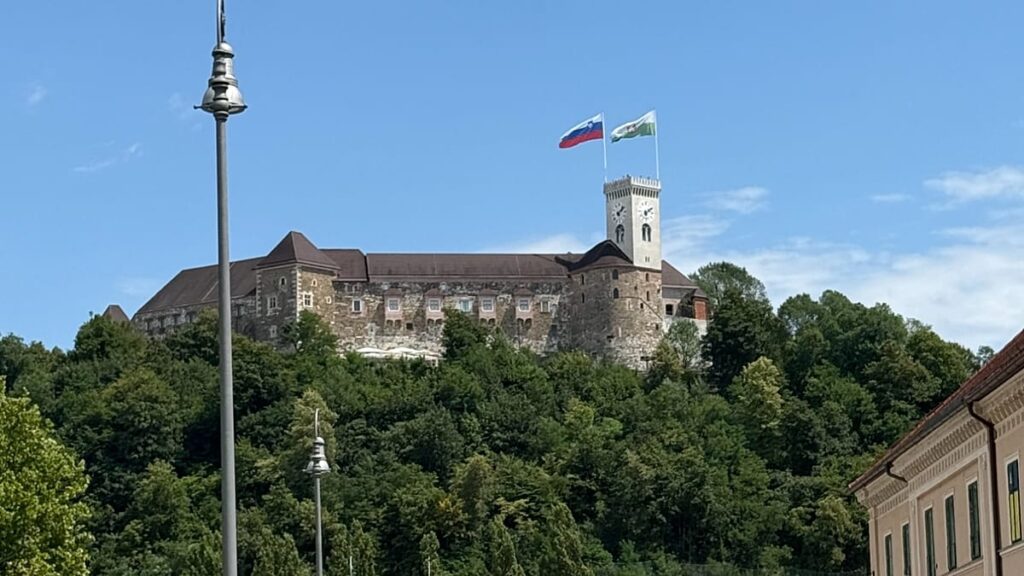
Above the old town rises Ljubljana Castle, a fortress with more than 900 years of history that can be reached either on foot or by funicular. From the top you get one of the best views over the city and, on clear days, of the mountains that herald the next stage of the trip.
Bled, Slovenia’s picture-postcard view
We leave Ljubljana and head towards the Julian Alps. Our next stop is probably the country’s most famous image: Bled. Its lake looks as if it had been made for the front of a postcard. Surrounded by mountains and forest, a tiny island crowned by a church rises out of the water, while a medieval castle commands the landscape from the top of a cliff.
But Bled is not just somewhere to take photos. A route of roughly six kilometres loops all the way around the lake. Cycling it is one of the best ways to discover the area because the scenery is constantly changing and you are forever stopping to admire it from different angles.
In summer it is hard to resist the water. There are designated swimming areas and, after pedalling around the shore, a dip with the Alps as a backdrop becomes one of those small experiences that explain why Slovenia works so well as an active tourism destination.
Bled is spectacular, but it is also one of the most visited places in the country. To find a slightly quieter side of Slovenia, you have to continue on towards Bohinj.
Bohinj, the wildest lake
The change is immediately obvious. Lake Bohinj, the largest permanent natural lake in Slovenia, is just over four kilometres long and lies at the heart of Triglav National Park.
Less touristy than Bled, it feels far more untamed. At certain times of day its waters are like a giant mirror. Mountains and forest are reflected on a surface that seems almost motionless, creating a blend of greens, blues and turquoises that is hard to forget.
There is no iconic island here to photograph. It is not needed. The landscape is the star. One of the best ways to enjoy it is by kayak. Paddling out onto Bohinj takes you away from the shore and lets you admire the mountains from another perspective. You can also swim, go paddleboarding or explore the shores by bike and on foot.
And just venturing into the surrounding mountains multiplies the options. Hundreds of kilometres of trails criss-cross this part of the Julian Alps. There are easy routes along the lakeshore and much more demanding ones that climb up into the peaks. Climbing enthusiasts will also find numerous rock faces and routes of varying levels of difficulty.
Everything unfolds under the watchful presence of Triglav which, at 2,864 metres, is Slovenia’s highest peak and one of its great national symbols.
Winding roads
Between Bohinj and our next destination, we discover another of the advantages of travelling across Slovenia. Distances are relatively short and driving is part of the experience.
The roads twist and turn through forest, mountains and small villages. The greenery seems endless. At times, the landscape inevitably calls to mind Switzerland, although here everything is more compact and, in many areas, still less crowded.
A camper van also allows you to stop when you wish, change your route and make the most of a country where a journey of just a few hours can completely transform the landscape. Our next destination is Bovec, in western Slovenia, right in the heart of the Julian Alps.
Bovec and the emerald river
Bovec is small, but it is one of Slovenia’s great adventure sports hubs. The reason becomes clear just a few kilometres outside the town.
The Soča river runs through this Alpine valley with water so intensely coloured that in places it barely looks real. Shades of turquoise, blue and emerald green mingle as the river winds its way between white rocks, gorges and forest.
It is one of Slovenia’s great natural stages and also one of the best places in the country to go in search of adrenaline.
Rafting, kayaking and canyoning are among the most popular activities. In summer it is common to watch from the bridges as groups of brightly coloured kayaks glide along the Soča’s crystal-clear waters.
But you do not have to throw yourself into the river to enjoy the valley. Bovec is an excellent base for hiking, cycling and mountain excursions in the surrounding peaks.
Among its natural attractions are the Boka and Virje waterfalls. Boka is one of the most spectacular falls in Slovenia, while Virje surprises visitors with its more intimate setting and the intense colour of its water.
For keen walkers, another destination is Krnsko Jezero, an Alpine lake at around 1,400 metres above sea level and framed by some of the region’s most impressive summits.
And for those travelling through this part of the country by road there is another challenge: the Vršič Pass. At 1,611 metres above sea level it is the highest road pass in Slovenia. Its countless bends cut through the Julian Alps, linking the Soča valley with Kranjska Gora and turning the journey itself into an experience.
Above Bovec rises the Kanin massif, traditionally known for high-mountain skiing and historically connected to Italy’s Sella Nevea area. Beyond the winter season, it offers an exceptional setting for hiking and mountaineering.
Bovec perhaps sums up Slovenia’s active spirit better than anywhere else: here the landscape is not just something to look at. It is there to be explored.
Škocjan: an expedition underground
Our final major stop takes us into a completely different world. We leave behind the mountains, lakes and rivers and head to south-west Slovenia to delve into the bowels of the earth.
The Škocjan Caves were declared a UNESCO World Heritage Site in 1986 and are one of the most impressive karst systems on the planet.
The architect of this landscape is the Reka river. Over thousands of years, the water has eroded the limestone rock to create a vast underground universe of galleries, chambers, waterfalls and canyons.
The visit begins on foot, but it soon becomes something very different from a conventional trip to a cave. As you descend and natural light disappears, the size of the caverns increases. The sound of the river begins to rise up from the depths and, at times, visitors have the feeling of having turned into expedition members.
Škocjan is home to one of the largest known underground river canyons in the world. The cave system extends for more than six kilometres of galleries and in places reaches over 200 metres deep. The tourist route covers roughly three kilometres and descends to around 144 metres below the surface.
One of the most impressive moments comes when you cross the Cerkvenik Bridge, suspended about 45 metres above the Reka river. The darkness, the sound of the water and the sheer rock walls surrounding visitors combine to create one of the most spectacular sights of the whole trip.
Visits are guided and the tour lasts around two hours. Even in the height of summer you need to come prepared: inside, the temperature is about 12 °C all year round, so it is advisable to bring warm clothing and, above all, comfortable shoes with good grip.
It is also a good idea to book tickets in advance. In the busiest months, tours can fill up, and turning up without a reservation may mean being unable to get in.
Škocjan or Postojna
Slovenia’s underground world offers yet another of the country’s major tourist attractions. Not far away are the famous Postojna Caves, although the experience there is very different.
Postojna is more tourist-oriented and more accessible. Part of the visit is made on board a small train that travels several kilometres into the cave system before the tour continues on foot among stalactites and stalagmites.
Škocjan, by contrast, feels much more like an adventure. There is no little train to soften the experience. You walk, you descend and you cross vast chambers while the Reka river keeps slowly carving out the rock beneath your feet.
Postojna impresses with its formations. Škocjan impresses with its scale and with the sensation of exploring an underground world.
Five days after setting off, Slovenia leaves a very clear impression: it feels much bigger than it looks on the map. Not because of its distances, but because of the diversity of experiences it offers.
For those who see active tourism as the best way to travel and discover a destination, this small country is a vast natural playground in the heart of Europe.
Read the full article here