

Subway ridership still trails pre-COVID pandemic levels — by a whopping 25% — even as transit officials rush to credit congestion pricing for getting New Yorkers back on the public transportation system.
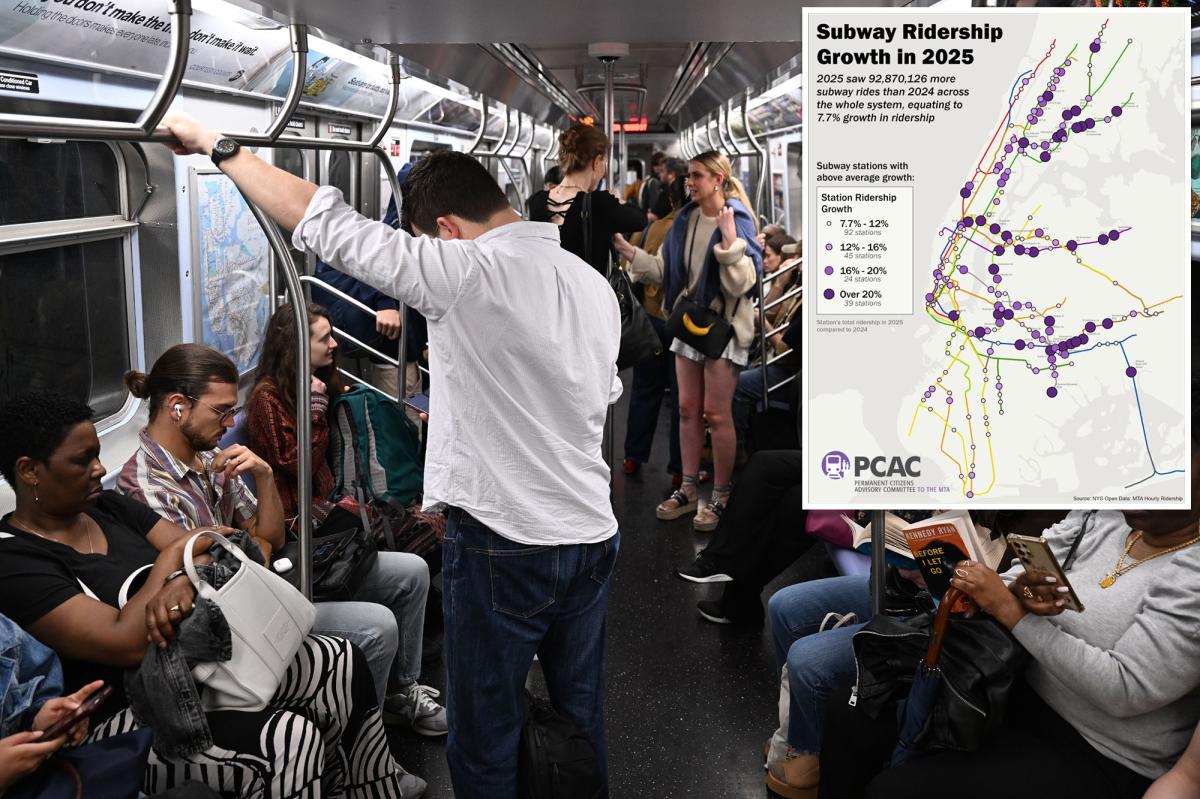
A recent report from the Permanent Citizens Advisory Committee to the MTA (PCAC), finds that New Yorkers took nearly 1.3 billion subway trips in 2025, about 7.7% more than in 2024.
But subway ridership still remains at only about 75% of pre-pandemic levels, leaving a sizable gap in the system’s recovery.
The report showed that ridership had been climbing for years, long before congestion pricing began on Jan. 5, 2025.
Still, the advocacy group, as well as Gov. Kathy Hochul and Metropolitan Transportation Authority leaders have cast the scheme charging drivers $9 to drive in Manhattan below 60th Street as a key reason riders are coming back.
“Speeds are up. Buses are faster. Transit ridership is up in the zone as well,” Hochul said at a Jan. 5 press conference marking the first anniversary of the toll.
A press release from the governor’s office about congestion pricing also touted an increase in subway ridership.
MTA chair Janno Lieber, speaking at the same press conference, labeled the program “good government in action.”
“At this point, I dare say anyone who’s paying attention and has a pulse is aware that congestion pricing has delivered and continues to deliver on all of the stated goals,” Lieber said.
Brian Fritsch, associate director at PCAC, even told Bloomberg in an article published Tuesday that the new toll prompted more drivers to take the subway instead of getting behind the wheel for both work and personal travel.
“It’s less about the Monday through Thursday — the new work week — which had a slightly slower growth year over year, and more about trips that people might have decided to make by car previously that they’re now doing via transit,” Fritsch claimed to the outlet.
But PCAC’s analysis contains no data showing the new toll was the main driver of last year’s ridership increase.
It notes instead that ridership had already been rising year after year from its 2020 low, and that growth since 2024 has been strongest outside of Manhattan.
Between 2024 and 2025, subway ridership rose 11.4% in The Bronx, 8.5% in Brooklyn and 7.3% in Queens, compared with a 7% increase in Manhattan — meaning outer‑borough stations outside the congestion zone saw broader gains.
PCAC’s report showed a steady increase in ridership even in the years prior to the congestion fee.
After subway use collapsed in 2020 — down 62% from the 1.7 billion subway trips taken in 2019 — ridership rebounded to 48% of pre‑COVID levels in 2021; 56% in 2022; 65% in 2023; 70% in 2024; and reached 75% in 2025.
MTA data also showed annual subway trips grew 18.8% in 2021; 33.3% in 2022; 13.7% in 2023; and 3.7% in 2024 — before jumping 7.7% in 2025.
PCAC also reports that weekend ridership is growing faster than weekday ridership, suggesting leisure trips remain a big part of the rebound.
An MTA spokesperson pointed to a ridership increase at the Times Square-42nd Street subway station, which had 2.5 million more rides taken in 2025 compared to the previous year, as proof of congestion pricing success.
“We agree with the PCAC’s findings that congestion relief has been a resounding success and that there been an increase in subway ridership inside the congestion relief zone and outside the zone.”
Read the full article here