



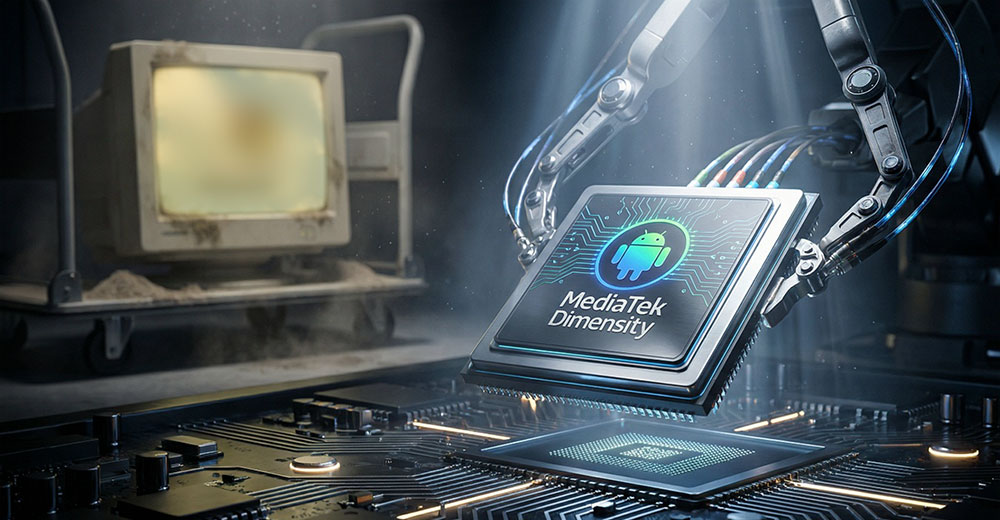
Last week, I attended the MediaTek analyst event, and the energy there was a stark contrast to the defensive posturing we’ve seen from the traditional PC incumbents lately. MediaTek isn’t just looking to be a value alternative anymore; it’s positioning itself as the foundational silicon for the next generation of AI-centric computing.
Seeing the company’s roadmap firsthand triggered a realization: the pieces are in place for a displacement of the x86/Windows hegemony. The industry is moving from a world of legacy compatibility to one of mobile-first efficiency, and MediaTek, alongside Google, holds the winning hand.
Microsoft Misreads Another Platform Shift
History has a nasty habit of repeating itself in Redmond. Decades ago, Microsoft owned the gateway to the internet with Internet Explorer, only to lose it through a combination of complacency and a catastrophic lack of focus. Microsoft treated the browser as a feature of the OS rather than the platform of the future. Today, we are seeing the exact same pattern emerge with the Windows desktop.
Microsoft has spent the last few years throwing everything at the wall — Copilot, Surface hardware, and half-hearted Arm transitions — without ever truly fixing the core Windows experience for the modern user. By failing to prioritize a lightweight, mobile-first, and app-centric architecture, they have left the door wide open.
Just as Chrome displaced Explorer by being faster and more integrated into the user’s digital life, an optimized “Android for PC” threatens to make Windows look like a legacy mainframe.
Intel’s x86 Fortress Is Crumbling
While Microsoft struggles with its identity, Intel is facing a fundamental architectural crisis. The once-impenetrable x86 fortress is under siege from all sides. Intel’s recent manufacturing missteps and the massive financial drain of its foundry business have left it vulnerable. More importantly, the power-efficiency gap between x86 and Arm has become a chasm that Intel can’t seem to bridge without sacrificing performance.
For years, the WinTel partnership was a mutual suicide pact: Windows needed Intel’s power, and Intel needed Windows’ ubiquity. But in a world where users value multi-day battery life and instant-on capabilities, that pact is failing. MediaTek has pivoted brilliantly into high-end silicon. Their Dimensity and Kompanio lines are now delivering performance-per-watt metrics that make Intel’s latest mobile chips look like heaters that happen to compute.
Developers Shift Toward Android
The ultimate bellwether for any platform’s health is developer engagement. If you look at where the most innovative, profitable, and high-frequency apps are being built, it’s not Windows; it’s Android. Developers are tired of the friction involved in building for the Windows Store and the complex legacy requirements of the Win32 API.
Android offers a unified development environment that spans from the smartphone in your pocket to the tablet on your desk and will expand to PCs shortly. If Google finally ships a fully baked Android for the PC, developers won’t have to port their apps — they can simply enable a desktop mode. This ready-made ecosystem of millions of apps creates an immediate day one advantage that Microsoft’s “Windows on Arm” has spent a decade failing to achieve.
Gemini vs. Copilot AI Gap
Microsoft bet the farm on its partnership with OpenAI, but Google’s vertical integration is starting to win the day. Google’s Gemini AI platform is increasingly seen as more cohesive than Microsoft’s Copilot. While Copilot feels like a layer of paint slapped onto an aging house, Gemini is being woven into the very fabric of the Android kernel.
Because Google controls the OS, the browser and the AI model, it can offer latency-free, on-device AI processing that Microsoft can only dream of. When you pair Gemini’s massive context window and multimodal capabilities with MediaTek’s dedicated NPU (Neural Processing Unit) hardware, you get a PC designed to support more proactive, context-aware workflows.
Microsoft’s Smartphone Miss
The fatal error for both Microsoft and Intel was their inability to secure a foothold in the smartphone market. By losing the phone, they lost the anchor device of the modern user. Google uses the Pixel and the broader Android ecosystem to build brand loyalty and data gravity.
When a user’s entire life is already on an Android phone, moving to an Android PC is a frictionless evolution. For Microsoft, trying to pull an Android user back into a Windows environment is an uphill battle. This gap in mobile presence creates additional competitive pressure on the PC ecosystem. Google doesn’t need to beat Windows at being a legacy PC; it just needs to convince users that their PC should work exactly like their phone.
What Do We Call This New Alliance?
While WinTel had a certain industrial ring to it, the Google-MediaTek partnership needs something more agile. “AndTek” is the obvious front-runner, signifying the marriage of Android and MediaTek. However, if we want to emphasize the platform’s AI-first nature, “GeminiTek” might be more appropriate.
Regardless of the name, this is a partnership of necessity and opportunity. MediaTek provides the affordable, high-performance silicon that can scale from budget laptops to high-end workstations, while Google provides the software and the massive user base. Together, they represent the first credible threat to the PC status quo in thirty years.
Qualcomm’s Risky Windows Bet
Qualcomm should have been the one to lead this charge. It has the silicon and the brand. However, its exclusive focus on Microsoft’s “Windows on Arm” has left it tied to a sinking ship. By the time Qualcomm realizes that Windows isn’t the future of Arm on the desktop, MediaTek and Google may have already locked up the OEMs.
To stay relevant, Qualcomm needs to pivot by stopping its efforts to make Windows run on ARM and start helping Google make Android run on the PC. If it doesn’t, they risk being relegated to the high-priced niche while MediaTek captures the volume of the market.
Google’s Attention Span Problem
The biggest threat to this new alliance isn’t Microsoft; it’s Google itself. Google has a well-documented history of shifting priorities across product initiatives. It launches brilliant products, loses interest, and then kills them (RIP Stadia, Google Glass, and a dozen messaging apps).
To displace Windows, Google must commit to a ten-year roadmap. Google needs a massive, consistent marketing campaign that explains why an Android PC is better. It needs to court enterprise IT managers who are currently terrified of the security implications of a mobile-first OS. If Google treats this as a side project, it will fail. If it treats it like the future of the company, it wins.
What a Post-WinTel World Looks Like
If AndTek succeeds, the world of computing changes overnight. We move away from the “Cycle of Bloat” where software expands to fill whatever hardware Intel provides. Instead, we get “Instant-On” PCs with at least 20 hours of battery life that stay cool to the touch.
The PC becomes a more transparent device — less about file systems and registry keys, and more about seamless access to web services and AI-driven workflows. The distinction between a mobile app and a desktop app disappears. In this world, the PC isn’t a destination; it’s just a bigger screen for your digital life.
Wrapping Up: WinTel Faces Its Biggest Challenge
The displacement of Windows and x86 isn’t just a possibility; it’s starting to look like an inevitability. Microsoft’s lack of focus and Intel’s architectural stagnation have created a vacuum that Google and MediaTek are uniquely positioned to fill. By leveraging the massive Android developer base and the superior efficiency of Arm silicon, this new alliance can redefine what a PC actually is.
The AndTek era promises a more integrated, AI-driven, and efficient computing experience. However, its success hinges entirely on Google’s ability to stay focused and MediaTek’s ability to scale into the premium tier. If they can execute, the WinTel era will soon be remembered as a quaint, noisy, and overheated chapter in tech history.
The HP Smart Tank 7602 All-in-One
In the world of technology analysis, we often focus on the flashy front-end devices — the foldable phones, the AI-integrated laptops, and the latest silicon from MediaTek or Intel. But the backbone of any productive home office remains the printer, a category that has, for too long, been defined by a “razor and blade” business model that prioritizes recurring revenue over user experience.
The HP Smart Tank 7602 is the rare exception that proves the rule: a piece of hardware designed to solve the problems it creates.
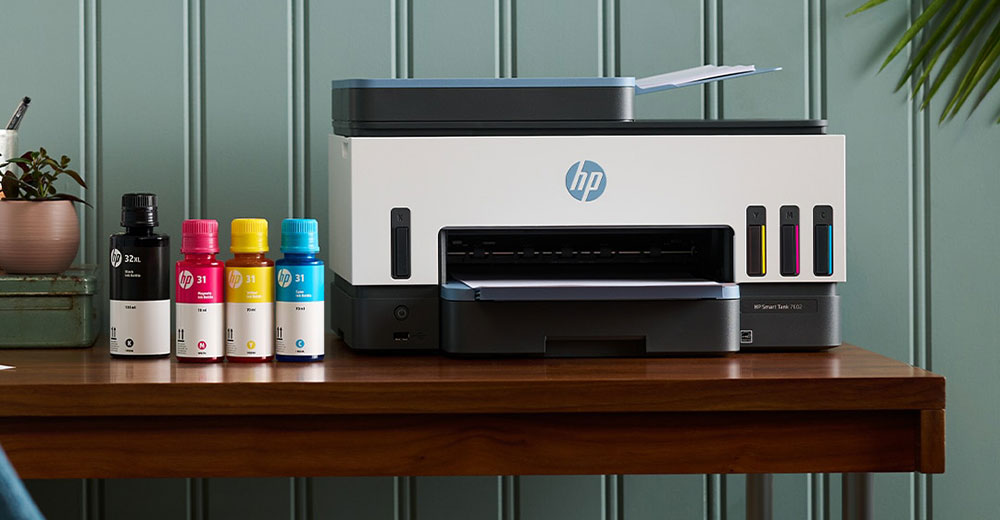

Image Credit: HP
What makes the 7602 technically differentiated isn’t just the “tank” branding; it is the sophisticated engineering of its ink delivery system and the integration of enterprise-grade sensors into a consumer footprint.
For decades, we’ve dealt with the “cartridge scam” — tiny plastic containers that run out at the worst possible moment and cost more than their weight in fine champagne. The Smart Tank 7602 moves the needle by providing enough ink in the box to last up to two years, fundamentally shifting the cost-of-ownership curve.
From a mechanical standpoint, the 7602’s primary advancement is its thermal inkjet technology combined with a high-capacity, spill-free refill system. Unlike older tank models, which were prone to air bubbles or clogs when left idle, HP has refined the fluid dynamics within the print head. This helps reduce issues when the printer sits idle for weeks; it primes itself efficiently without wasting a quarter of your ink supply on a cleaning cycle.
Modern Interface and Connectivity
The interface is where the 7602 truly steps into the modern era. Most printers in this class settle for an archaic two-line LCD that feels like a relic from the 1990s. HP has instead implemented a “Magic Touch” panel.
This contextual UI only illuminates the buttons you need for the task at hand. If you aren’t scanning, the scan buttons disappear. This reduction in visual noise is something I’ve advocated for in PC design for years; it lowers the cognitive load on the user and makes the device feel like an assistant rather than a chore.
Connectivity is another area where the 7602 shines, utilizing dual-band Wi-Fi with self-healing capabilities. In a crowded spectrum environment — like a home filled with smart devices, dog cameras, and mesh routers — printers are notoriously the first things to drop from the network. The 7602’s ability to proactively switch bands and reconnect without user intervention is a technical win that saves hours of IT support time for the family.
Furthermore, its integration with the HP Smart App enables a level of mobile-first productivity that aligns with the “AndTek” future I’ve been discussing. You can scan documents directly to a mobile device, OCR the text in the cloud, and have it filed in your records before you even walk back to your desk.
Durability and Long-Term Value
We should also discuss hardware durability. The 7602 features a robust 35-page automatic document feeder (ADF) that handles mixed-weight paper without the rhythmic jamming that plagues lower-end units. For a technology analyst who still deals with physical NDAs or printed manuscripts, this reliability is paramount.
The print quality — especially for black text — rivals entry-level lasers, offering sharp, pigment-based blacks that don’t smudge under a highlighter.
Sustainability is the final pillar of its differentiation. By eliminating the plastic waste of hundreds of cartridges over the life of the machine, the 7602 aligns with the growing industry shift toward circular economies. It is a “buy it once, use it for a decade” machine in a world of disposable tech.
Positive industry sentiment mirrors my own experience, with reviewers praising the 7602’s low running costs and its balanced feature set for the small office. While it carries a higher upfront cost than a $99 loss-leader inkjet, the ROI is realized within the first year for a high-volume user. It represents a rare moment where a legacy manufacturer listens to the market and builds a product that prioritizes the user’s wallet and sanity over the quarterly consumables report.
The HP Smart Tank 7602 All-in-One is my Product of the Week because it successfully replaces the frustration of the cartridge-based past with a high-capacity, technically superior, and economically rational printing solution for the modern professional.
Read the full article here