



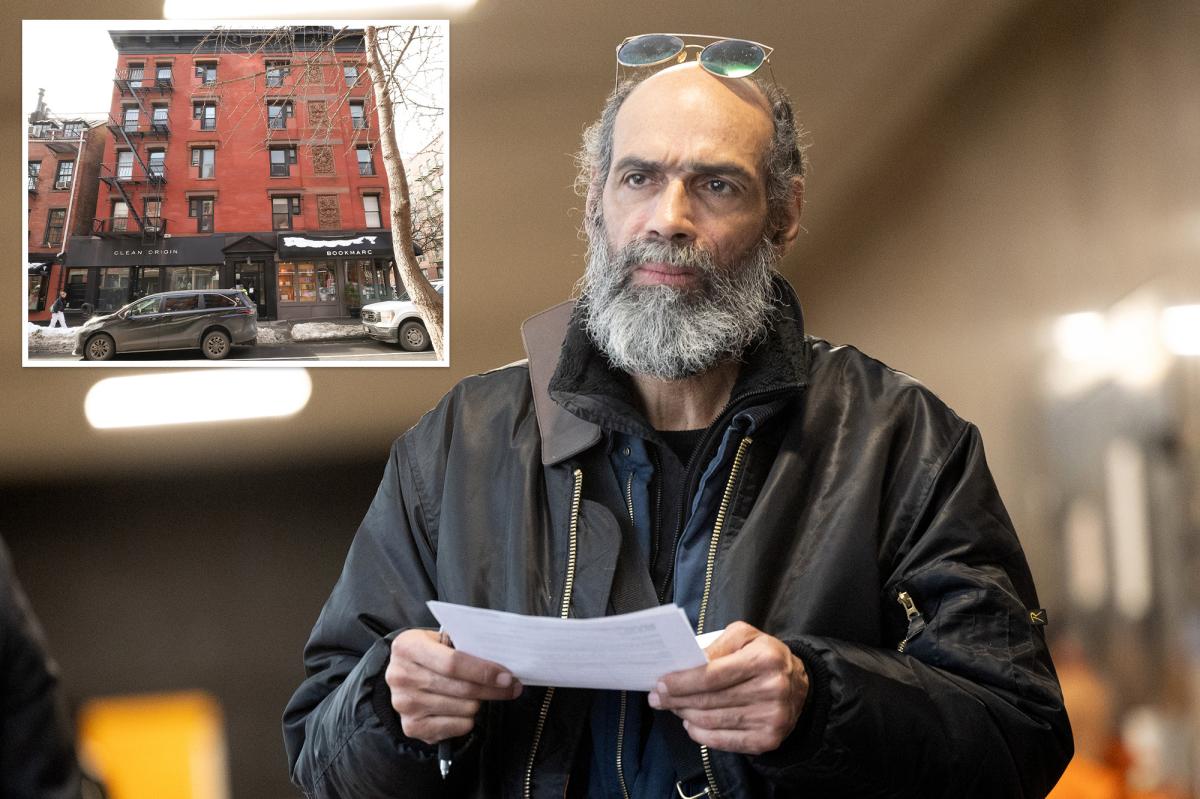
An accused squatter from hell could actually have a claim to the rent-controlled pad in a swanky West Village building where he’s allegedly been terrorizing neighbors for months, legal experts said.
Melvin DeJesus, 66, moved into the 5th-floor unit at 400 Bleecker St. roughly two decades ago when a lifelong New Yorker with a “heart of gold,” John Grafenecker, took him in, a close relative of the late tenant said.
“John really took care of Mel no matter what — he paid a lot of bills, food, Con Edison,” said Grafenecker’s kin, who asked to remain anonymous.
“He had a very good heart.”
DeJesus stayed in the apartment after Grafenecker’s death at 84 last year and is now facing possible eviction — as the building owner claims he turned the enviable digs into a “flophouse” and has been making death threats against his neighbors, The Post previously reported.
But the alleged terrifying tenant could have a right to keep the coveted rent-controlled unit, according to guidelines governing the scarce affordable housing supply.
“As horrible as the behavior is, it seems in this case that this squatter may actually have succession rights to this apartment,” said David Schwartz, an attorney at boutique New York City-based law firm Aidala Bertuna & Kamins PC.
The roughly 16,400 rent-controlled units in the city require continuous occupancy — either by the original tenant or “lawful successors” — since 1971, according to the city’s Rent Guidelines Board.
Succession rights are triggered when someone has lived in the unit for over two years and proves some sort of relationship — familial, romantic or financial — with the primary tenant.
DeJesus has claimed in court papers that he has legal right to remain in the apartment because the now-deceased longtime tenant was actually his gay lover of 30 years.
But DeJesus’ claim to Grafenecker’s home of 79 years made his relative ”furious.”
“I don’t think he has any right to do that,” the family member fumed, telling The Post that Grafenecker and DeJesus were essentially roommates.
“That’s news to me,” the relative said of DeJesus’ claim that the two were domestic partners.
The eviction case against DeJesus is ongoing, but Schwartz said The Brodsky Organization’s $5.5 million lawsuit against the accused nightmare tenant could see him banned from the building — regardless of the outcome in housing court.
“Once this starts affecting other people in the building and creates a dangerous situation, it goes beyond the scope of landlord tenant law,” Schwartz said.
“If this were happening somewhere else besides New York City, this person would have been thrown out already.”
Grafenecker’s kin recalled that DeJesus was “pleasant” sober, but said they saw first-hand the “very nasty, very violent” behavior — described by neighbors and in court papers — as his apparent drug and alcohol problems grew.
“[Grafenecker] was appalled by it,” and made several reports to police, though continued to foot DeJesus’ bills, the relative claimed.
“[Grafenecker] was a good person,” his family member said. “He had a heart of gold… he wasn’t appreciated by Mel.”
While the story of how the odd duo two met is unclear, Grafenecker’s life as a village fixture is rich in detail.
He moved into 400 Bleeker St. as a five-year-old in 1946 and lived there until his death from natural causes in October.
A graduate of the School of Visual Arts, he ran boutiques in the village, including one once directly across the street from his lifelong home called “Two of a Kind.”
That was a play on the name of his first shop, “One of a Kind.”
“Elton John came in and bought a whole bunch of stuff,” the relative told The Post. “They went out to dinner.”
His third boutique on Charles Street, “Sheik,” was featured in a 1979 New York Times story.
Grafenecker later became a gardener, doing projects inside building lobbies and for private gardens.
“He loved that, and was very good at it,” his relative recounted, and continued working until a few years before his death.
Grafenecker’s apartment — which he likely rented for a fraction of the market cost — would lose its rent-controlled status should DeJesus get the boot.
But because the building — where a two-bedroom apartment recently rented for $6,700 a month — has over six units, it would likely enter a less restrictive affordability program, rent stabilization, instead of being offered at market rate.
At a hearing for the landlord’s eviction case Tuesday, a court clerk mentioned the pending lawsuit in Manhattan Supreme Court against DeJesus — which seeks an order to ban him from the building.
“What am I going to do?” DeJesus replied, “sleep on the streets?”
DeJesus declined to comment when reached by phone.
His daughter told The Post that he’s estranged from his family.
Read the full article here