


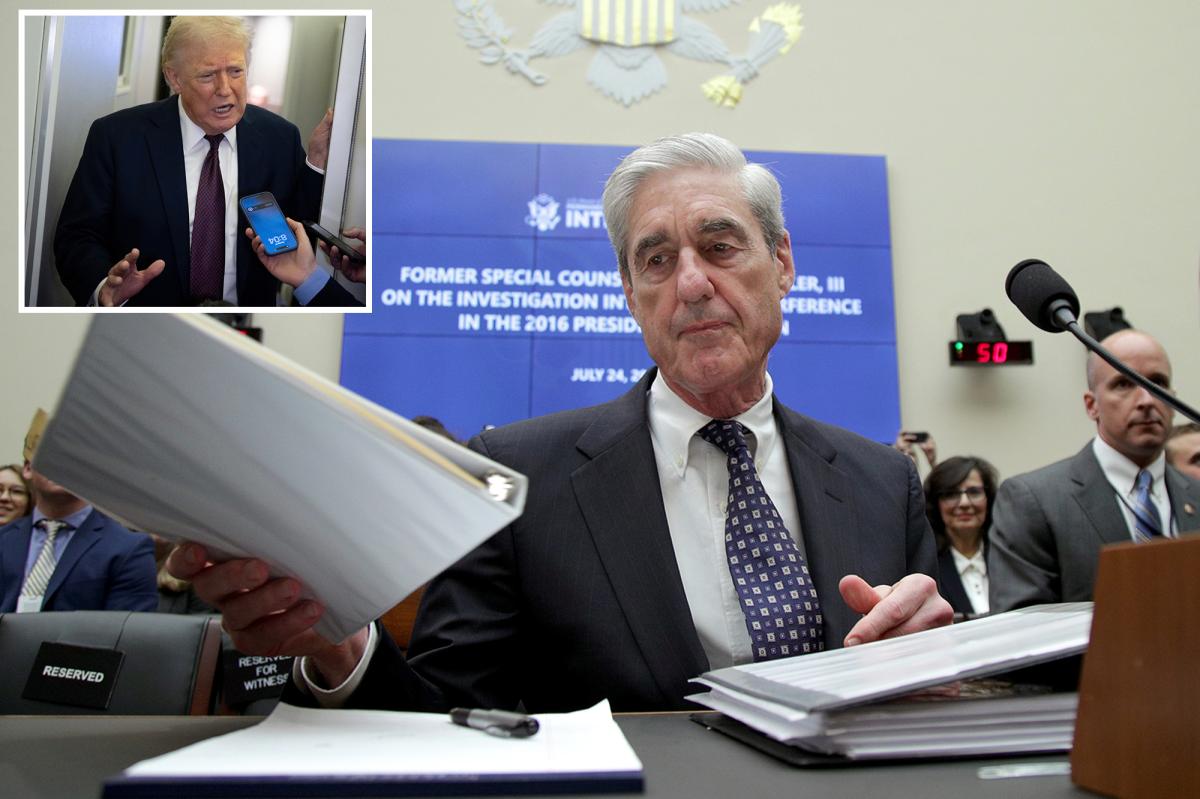
An FBI agent assigned to then-Special Counsel Robert Mueller’s investigation into Donald Trump’s 2016 campaign has made bombshell allegations charging misconduct, political bias, and “overzealous thoughts” permeated the team — to the point of festooning the walls of their office with anti-Trump cartoons and drinking alcohol while on the job.
A “let’s get him” attitude colored the two-year investigation into false claims that Trump and his advisers colluded with Russia to win the 2016 presidential election, the unidentified agent said.
The allegations were first made in December 2020, when the agent was interviewed as part of an internal FBI probe into alleged misconduct by then-supervisory intelligence analyst Brian Auten — a central figure in both the Russia collusion hoax and Hunter Biden laptop coverup.
In a Sunday night letter to Attorney General Pam Bondi and FBI Director Kash Patel, Senate Judiciary Committee Chairman Chuck Grassley (R-Iowa), detailed the most troubling aspects of the agent’s account, saying it “confirms long-standing concerns that political bias rotted the decision-making process within the Mueller team … The American public deserve answers.”
Among the most damning allegations:
- There was “no authority” for the Special Counsel’s Office to open a case on Tom Barrack, a billionaire friend of Trump’s and chairman of his 2017 inaugural committee, over false claims that he was an unregistered agent of the United Arab Emirates. The FBI’s Washington Field Office already had declined to open an investigation into the now-78-year-old but the Mueller team nevertheless arrested Barrack, held him in jail, and charged him with being an agent of a foreign government. After a lengthy and expensive legal battle, Barrack was acquitted by a jury in 2022. He now serves as US ambassador to Turkey.
- The Mueller team chronically abused federal surveillance, or FISA, warrants that govern secret monitoring of suspected foreign agents to target Trump campaign advisers, even renewing them over the objections of FBI agents. In one case, the agent claimed, “the target of the investigation [was] cooperating and the [surveillance warrant] would not give us anything more and there was nothing in the past FISA that aided the investigation other than to prove the Target was being honest with the investigators … there were no corroborating facts that tied [the target] to certain facts that we thought were originally true.” When investigators decided to apply for a fourth warrant against the aide, the agent pointed out a series of needed corrections. In response to the proposed revisions, FBI lawyer Kevin Clinesmith told him: “We can’t send this.” The DOJ subsequently decided the corrections weren’t needed. Clinesmith later pleaded guilty to doctoring an email that underpinned a FISA warrant application for another blameless Trump adviser, Carter Page. He was sentenced to 12 months probation and kept his law license after a short suspension.
- Mueller prosecutor Zainad Ahmad, a protege of former Barack Obama Attorney General Loretta Lynch, repeatedly violated security protocols: “For example, she brought classified documents to a meeting at WFO [Washington Field Office] without adherence to FBI security policy by bringing her classified notebook to the meeting without a proper carrying bag. What was worse, she came to WFO from her residence, meaning she kept her notebook at the residence.”
- Former FBI Deputy Director Andrew McCabe “referred to President Trump in a derogatory manner” in an official interview record — and DOJ prosecutors later tried to pressure FBI agent Michelle Taylor to “change the tone of the [document] to reflect that McCabe spoke about [Trump] without the negative connotation.” Taylor refused and left the FBI shortly after her secondment to the Mueller team ended, the agent said.
- A “general atmosphere … of bias [in the office was] led by one young prosecutor, Aaron Zelinsky … There were caricatures and cartoons that were anti-Trump.” Zelinsky, who handled the zealous investigations into Trump advisers Roger Stone, George Papadopoulos and Michael Caputo, resigned from the DOJ in January 2025.
Mueller’s investigation ran until March 2019, at a cost to taxpayers of more than $30 million, but found no evidence of Russia collusion.
In May 2023, another special counsel, John Durham, released a report describing the Trump-Russia probe as “seriously flawed” and finding that the FBI “discounted or willfully ignored material information that did not support the narrative of a collusive relationship between Trump and Russia.”
Grassley has asked Bondi and Patel to produce all emails, files and personnel records relevant to the agent’s allegations by March 29.
Read the full article here