




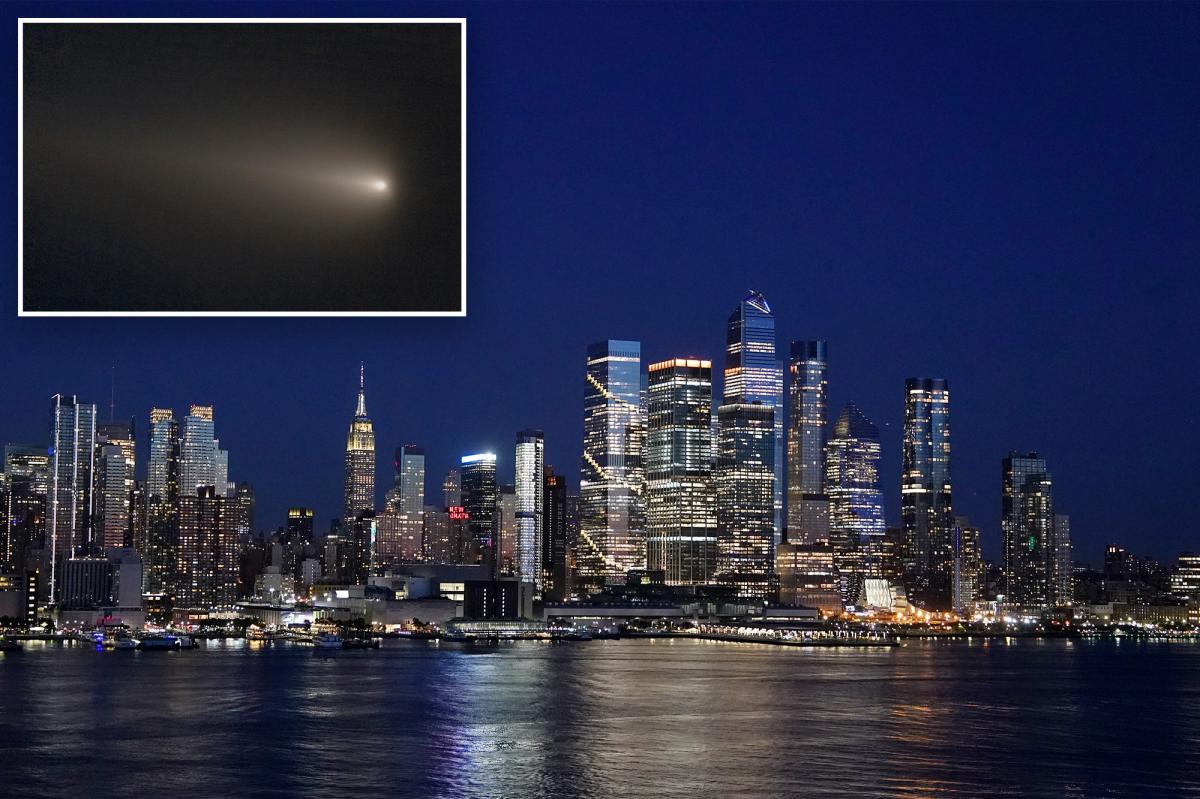
New York City stargazers could be less than a week away from getting a glimpse of a comet blazing its way through the cosmos as Comet C/2026 A1 MAPS passes just 89 million miles from Earth.
The roughly 1-mile diameter “sun grazer” comet — named for its (relative) close proximity to our solar system’s only star — is expected to pick up a generous dose of radiation from the sun as it passes, which will give it a brilliant bright glow and a lengthy tail.
The comet will appear high in the sky between April 5-8 after its solar radiation bath, and can be best spied by gazing to the southwest at dusk where the sun is setting.
Experts are hoping it puts on a dazzling lightshow — on par with the brightness of a neighboring planet — but as is the case with all things celestial, there are no guarantees.
“Comets are notoriously fickle,” Jackie Faherty, astrophysicist at the American Museum of Natural History told Gothamist.
“As exciting as they might be, sometimes they just peter out on us, but it’s got a lot of potential. It could be as bright as Venus.”
The comet could also disintegrate as it passes the sun, which would rob New Yorkers of an early-spring cosmic lightshow.
The latter half of April also presents an opportunity to see the night sky dotted with shooting stars during the Lyrids meteor shower, expected between April 14-30, and peaking April 21-22 when as many as 20 meteors could appear each hour.
The best time to catch a glimpse of the Lyrids from the Big Apple is after 10 p.m.
Capping off an April full of chances to spy some free out-of-this-world entertainment courtesy of comets and meteors will be the NASA’s first manned moon launch in 50 years — expected to blast off from Kennedy Space Center in Florida sometime this month, as weather permits.
The 10-day mission won’t involve any astronauts making lunar landfall, but instead travel in a figure-eight path around the Earth and moon as a test of the space agency’s launch system for the upcoming Artemis III, in which humans are planned to land on the moon by 2028.
If all goes as planned, it will be the first time human beings walked on the moon since the Apollo 17 mission in December 1972.
Read the full article here