




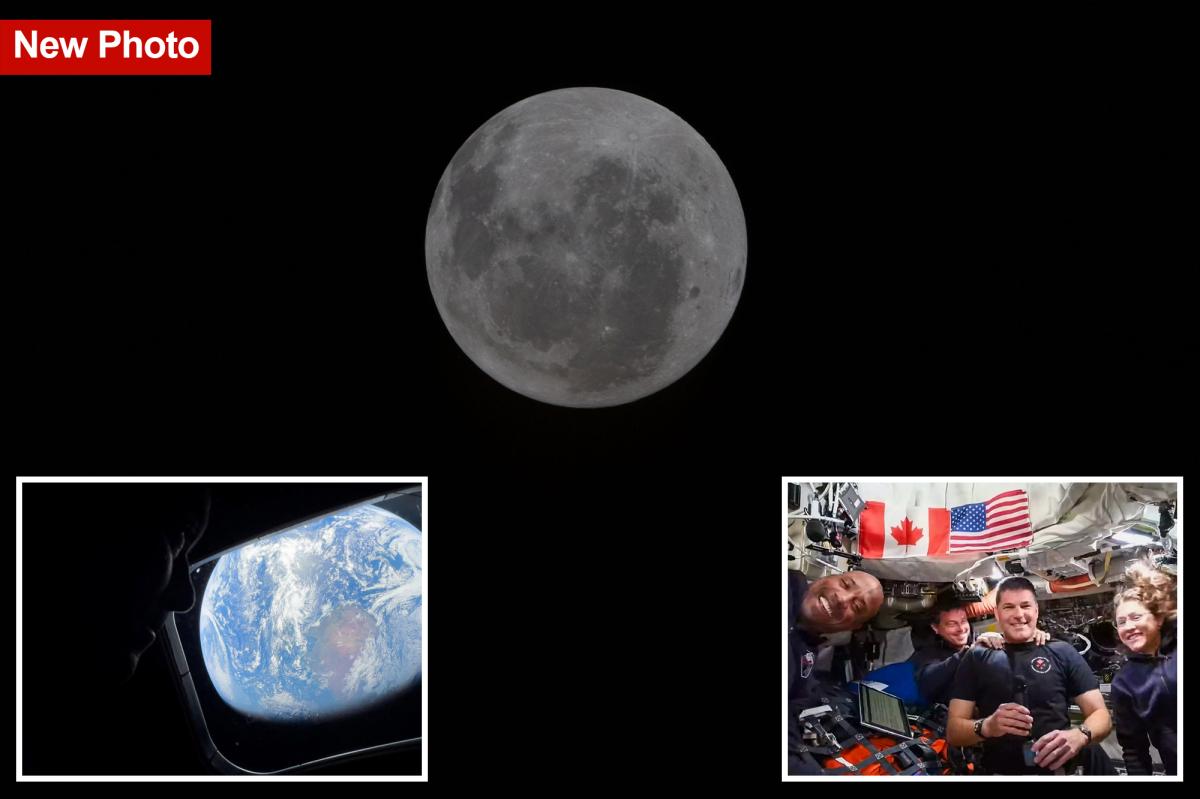
The Artemis II astronauts saw a side of the moon never before seen by human eyes over the weekend — but it was just an appetizer for their historic lunar flyby expected to begin Monday afternoon.
Orientale basin — a huge, black impact crater on the far side of the moon — came into full view of Artemis II on Saturday, with the crew beaming back stunning photos of the formation as they hurtled through space about 200,000 miles from Earth.
“In this new image from our @NASAArtemis II crew, you can see Orientale basin on the right edge of the lunar disk,” NASA wrote while sharing the photo in a Sunday X post.
“This mission marks the first time the entire basin has been seen with human eyes,” the space agency hailed.
“History in the making.”
But it was just the first of many historic glimpses the four-person crew will get in their 10-day mission around the moon — the real show is expected to begin around 2:45 p.m. EST, when the spacecraft begins its highly-anticipated lunar flyby.
The flyby should last just over six hours and end around 9:20 p.m., with a roughly 40-minute communications blackout beginning around 6:47 p.m. as the moon blocks signals between the Artemis II Orion capsule and Earth.
During that time the crew will be flying around the moon at altitudes between 4,000 and 6,000 miles, and the moon will appear through the capsule windows to be about the size of a basketball held at arm’s length.
But the astronauts will be seeing what no human eye has ever seen — the far side of the moon, which is perpetually locked from view on Earth and was hidden in shadow during every Apollo mission that orbited the over 50 years ago.
The far side has been closely photographed, but only by unmanned probes.
The crew already began trying to wrap their heads around the surreal experience of seeing a whole new view of the moon as they approached over the weekend.
“The darker parts just aren’t quite in the right place,” astronaut Christina Koch told NBC News from the Artemis II capsule Saturday.
“Something about you senses that is not the moon that I’m used to seeing,” said Koch, who has also become the first woman in history to see the moon up-close at all.
“That is the dark side,” she added. “That is something we have never seen before.”
Artemis II spent Friday and the weekend cruising through the vacuum between the Earth and moon — a distance known as the cislunar space.
On Thursday it fired its thrusters for the translunar injection, propelling the rocket to a speed of more than 22,000 mph and breaking free from Earth’s orbit just over a day after launch.
The capsule gradually slowed as Earth’s gravity continued to pull on it — but everything began speeding up just before 1 a.m. Monday as Artemis II fell into the moon’s gravitational sphere of influence.
Lunar gravity is what will fling Artemis back to Earth — the moon’s pull acting as a slingshot that will give it the momentum for its return trip — with no firing of the thrusters needed after Monday night’s flyby.
It’s the same trick of physics employed by Apollo 13 in 1970 to get its derelict capsule home while using minimal fuel and power — and which enabled Apollo 13’s crew to make history for travelling further from Earth than any humans in history.
But Artemis II will break that record with their slingshot move — cracking Apollo 13’s 248,655 mile record by some 4,000 miles — with an expected maximum distance of 252,757 miles from Earth.
The record is expected to be broken at 1:56 p.m. Monday — almost an hour before the flyby begins — with the new record expected to be set by 7:05 p.m.
From there, Artemis II will be riding back home and humanity will be closer still to its planned historic return to the moon.
A manned lunar landing is currently scheduled for 2028 following a 2027 Artemis mission in Earth’s orbit, with the space agency expected to set its sights on Mars in the years to come.
Read the full article here